Stickman Teleport Master 3D
- 4.5
- Rating
- 10.00M
- Installs
- Free
- Price

 Analysis by App-foxy
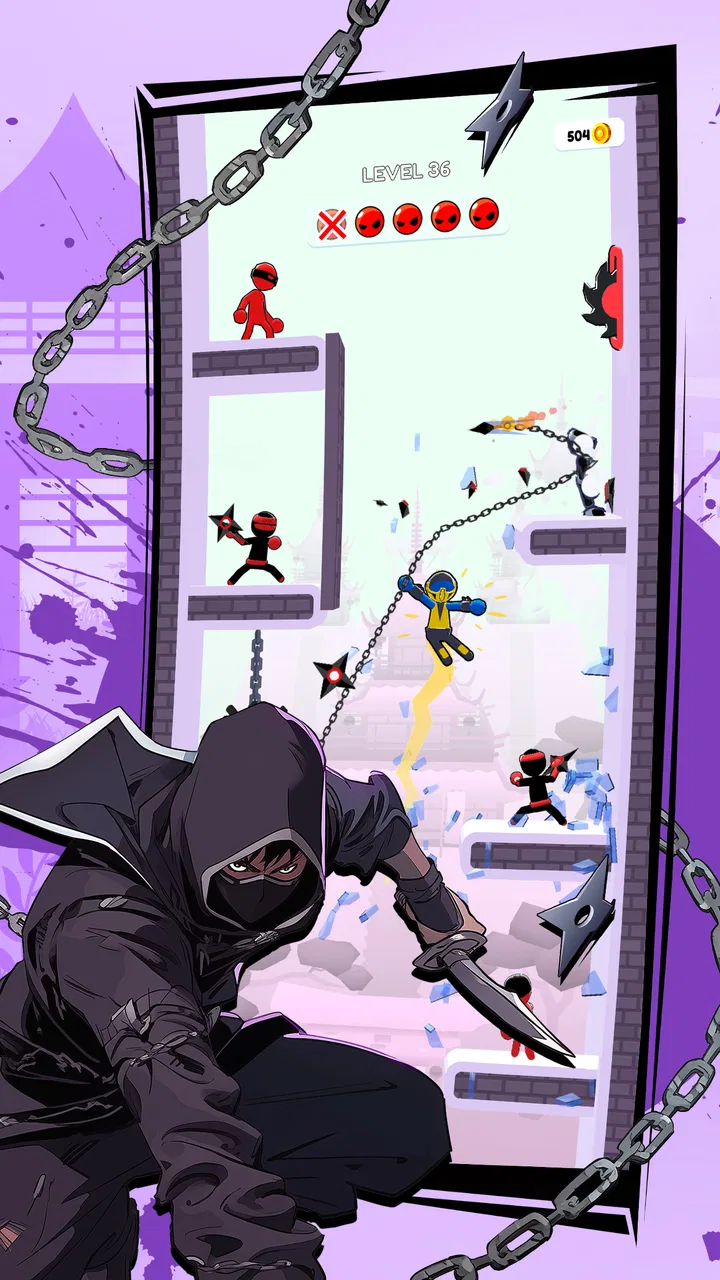
I spent time with Stickman Teleport Master 3D as a quick-action game built around a simple idea: aim a kunai, move through space, and take down ninja enemies as a stickman assassin. That premise is easy to understand almost immediately, but the real test is whether the controls stay readable and manageable once the screen becomes busier. My experience was that the game is at its best in short sessions, especially when I want something direct rather than a large adventure with a long story or complicated character build.
It comes from CASUAL AZUR GAMES and sits in the action category. The game is free to start, with optional in-app purchases priced at $11.99 per item. It has a Teen content rating, so I would not treat it as a game for very young children simply because the characters look cartoonish. The visual style is light and stylized, but the central activity is still combat against ninja enemies.
How the game reads and guides you through action
The strongest part of the presentation is its immediate visual language. A stickman character, a kunai, and enemy targets communicate the basic objective without requiring a long explanation. I did not need to learn a complicated menu system before understanding what the game wanted me to do. That makes it approachable for anyone who prefers action games that teach through the first few moments rather than through extended instructions.
You May Also Like

 Blood Strike: 2.5 Anniversary
Blood Strike’s Loadouts Turn Every Drop Into a Tactical Gamble
A close look at Blood Strike’s custom loadouts: how fast access to signature weapons reshapes its battle royale rhythm, rewards preparation, and narrows the gap between fights.

 Pandora - Music & Podcasts
Pandora’s Music Is Easy to Start, but Harder to Recover
Pandora’s strength is its low-effort path from a seed to a station. Its weak spot is how much confidence it asks you to place in connection, setup, and quiet recovery.

 8 Ball Pool
 Is Built on Rivalries, Rematches, and Routine
A close look at the rivalries, rematches, shared routines, and unanswered safety questions that turn a quick pool match into a persistent mobile community.

 Samsung Music
’s Quiet Strength Is Playing What You Already Own
Its reach comes less from spectacle than from dependable access to a personal library. That simplicity is both the app’s strongest retention engine and its ceiling.

 AccuWeather: Weather Radar
AccuWeather Review: A Quick, Clear Forecast for Everyday Decisions
For everyday plans, the best forecast is the one you can understand quickly. AccuWeather makes rain timing, radar, and local conditions easy to act on, with a few trade-offs.

 Hill Climb Racing
Why Hill Climb Racing Still Turns Crashes Into One More Run
A tiny car, a bumpy hill and one more upgrade: Hill Climb Racing keeps resurfacing because its simple chaos makes every near-miss feel personal.
More From Our News Desk



Teleportation is also a useful idea from a readability standpoint. Instead of asking me to move a character through a large environment with several virtual buttons, the game focuses attention on the relationship between the kunai and the next position. That gives each encounter a clear visual question: where should I throw, and where will that move place me? When the scene is uncluttered, this makes the action feel more deliberate than a typical button-mashing game.
There is a trade-off, though. A mechanic based on aiming and repositioning can become visually demanding when several enemies or hazards compete for attention. I found that the most important skill was not simply reacting quickly, but pausing mentally long enough to identify the safest target. Players who enjoy planning a short sequence of moves may appreciate that rhythm. People looking for a completely relaxed game may find the need to track targets and timing tiring.
Navigation outside the action matters just as much for a comfortable experience. The game’s appeal depends on getting into a round quickly, and its compact concept works better when the route from opening the app to playing remains simple. I would recommend taking a moment to look at the available controls and purchase prompts before handing the phone to another player, particularly if that person is unfamiliar with mobile games. The free entry point is convenient, but optional purchases mean that a shared device deserves a little supervision.
For players who have difficulty reading small interface elements, the stickman art helps in the play area because characters are visually distinct from the background. However, I would not assume that every menu label or on-screen prompt will be equally comfortable for every reader. Screen size, brightness, and the player’s distance from the device can change how easy it is to identify targets. A larger phone or tablet may be more comfortable than a compact handset for someone who needs more visual space.
Why the kunai mechanic feels different from ordinary action games
In many mobile action games, movement is handled with a virtual joystick while attacks are assigned to buttons. Here, the kunai is more than a weapon: it is part of the movement logic. That creates a different kind of concentration. I was not only asking which enemy to hit; I was also considering where the attack would leave me. This makes the game feel closer to a sequence of small positioning puzzles than to a conventional arena brawler.
That distinction is useful when choosing between this and the usual alternatives. If you want a character you can freely run around with, a traditional action game may feel more natural. If you prefer short decisions with a visible payoff, this teleport-focused structure is more appealing. It also suits players who like replaying a situation to improve their route rather than spending a long time developing a character.
One practical tip is to avoid treating every enemy as an immediate target. I had better results when I first looked at the whole arrangement, then chose a kunai destination that solved two problems at once: reaching an enemy while also creating a safer position. That habit is more valuable than simply trying to throw faster. It also reduces unnecessary frantic movement, which can help players who find rapid touchscreen input uncomfortable.
Motor, sensory, and situational considerations
The game’s control concept can be appealing for players who prefer a small number of meaningful gestures over a cluster of tiny buttons. Aiming the kunai and using it to teleport gives the action a clear central input. Someone who struggles with remembering several attack commands may find this easier to understand than a fighting game with multiple abilities, cooldowns, and directional combinations.
At the same time, a single central gesture can still demand precision. Touchscreens do not provide the physical feedback of a controller, so a player with limited fine-motor control may have difficulty making consistent throws, especially when speed matters. I would test the game in a calm setting before deciding whether it is suitable for a particular player. A stylus or a larger screen might make targeting more manageable for some people, although the game itself does not promise specialized accessibility support.
Players with hand fatigue should think about session length. The game is naturally suited to brief bursts, and I would use that to its advantage rather than trying to play continuously for a long stretch. A few rounds followed by a break can be more comfortable than gripping the phone and repeating the same movement until accuracy drops. This is also a good approach for younger or less experienced players who may become frustrated when a missed throw changes the outcome of an encounter.
Visual attention is another important factor. The stickman presentation is intentionally simple, but simple art does not automatically mean low sensory demand. Fast target changes, contrasting figures, and the need to follow the kunai’s destination can still require sustained focus. Players who are sensitive to motion or busy action should try the game at a comfortable brightness and avoid playing in a distracting environment. I found that a quiet setting made it easier to plan rather than react impulsively.
Sound can influence the experience as well, even though I would not choose this game primarily for audio. If you are playing in a public place, a waiting room, or beside someone who is sleeping, using the phone quietly is the considerate option. The game’s core idea remains understandable through its visuals, which is helpful when sound is unavailable, but I would not claim that every audio cue is replaceable for every player. The safest approach is to judge the experience on your own device and hearing needs.
For someone who uses a phone one-handed, the game may be easier than a control-heavy action title, but that depends on how accurately the throwing gesture can be performed with one hand. I would not recommend assuming that one-handed play will suit everyone. A secure grip matters, especially because a missed touch can be caused by the way the phone is held rather than by a lack of understanding. A stand or stable surface could make testing more comfortable.
A realistic everyday use case
I can see myself opening this game while waiting for an appointment or during a short commute when I have only a little time and want an activity that starts quickly. I would not choose it for a long flight if I wanted a deep campaign, a rich story, or a broad collection of systems to explore. Its strength is the compact decision loop: identify the target, choose a teleport route, act, and reassess.
That same short-session quality can help players whose attention comes in brief periods. Someone who does not want to remember a complicated plot after a break can return to the basic objective without much preparation. The downside is that repeated action may feel narrow to players who need constant variety. If the kunai-and-teleport loop does not remain interesting for you, the game has less else to fall back on than a larger action title.
It may also work as a casual challenge between friends using the same device, provided everyone is comfortable with the Teen rating and the combat theme. I would keep purchases in mind when sharing the game with children or anyone who might tap through prompts without understanding them. Free installation makes trying it easy, but “free” should not be confused with a completely purchase-free experience.
Where access becomes less comfortable
The main barrier is the dependence on accurate touch input. A player with tremors, reduced dexterity, or difficulty judging a small target may experience more failed attempts than another player. That does not make the game unusable for everyone with a motor limitation, but it does mean that suitability is personal. The best test is whether the player can aim without pain or repeated strain, not whether the game appears visually simple.
Another limitation is the lack of a clearly specialized control approach in the experience I reviewed. I would not choose it for someone who specifically needs remappable controls, switch access, guaranteed screen-reader support, or a carefully documented accessibility interface. A game designed around one fast touchscreen action can be welcoming in principle while still leaving important needs unaddressed.
Visual crowding may become a problem for players with low vision or difficulty distinguishing overlapping objects. The stickman style provides a clean identity, but the player still has to locate enemies and anticipate the result of a throw. Increasing the phone’s system text size may not enlarge every game element, so it should not be treated as a guaranteed solution. A tablet or larger display could help, but the result will depend on how the game scales on that device.
People who are sensitive to combat imagery should also consider the Teen rating before installing. The presentation is stylized rather than realistic, yet the purpose of the game is defeating ninja enemies. That makes it a poor fit for someone seeking a nonviolent puzzle or a purely relaxing visual toy, even if the controls appear uncomplicated.
There is also a privacy-of-attention issue in everyday use. Because the game asks me to focus on the screen for each encounter, I would not play it while walking, crossing a street, or doing anything that requires environmental awareness. This sounds obvious, but the short-round format can make it tempting to start “just one” moment anywhere. It is better suited to a stationary break where both hands and attention are available if needed.
Who should choose it, and who should look elsewhere
I would recommend it to players who like stylized action, short attempts, and movement systems that reward choosing the right target rather than holding down an attack button. It is especially interesting if you enjoy discovering efficient routes through compact encounters. The game’s free price makes it easy to test whether that specific idea suits you before spending anything.
I would point a different way for players who want deep character progression, a large narrative, online competition, or a broad accessibility settings menu. A traditional action game may be better for someone who wants free movement and familiar controls. A turn-based game may be a better choice for someone who needs more time between decisions. A noncombat puzzle game would be more appropriate for anyone uncomfortable with the Teen-rated ninja theme.
The current version is 0.0.50, and the game supports devices using Android 7.0 or later. That makes checking the operating system important before downloading, particularly if you are installing it on an older phone. I would also leave some storage and battery headroom for general phone comfort, although the game’s short-session design means it is not something I would expect to use as a full-day activity.
Its audience is already substantial: the game has passed ten million installs, with an average rating of 4.4 from around fifty thousand ratings and about one thousand eight hundred written reviews. Those figures suggest that the central concept has reached many players, but they do not replace personal testing. A popular control style can still be a poor match for someone who needs slower input or more explicit accessibility options.
My inclusive verdict after playing
What I like most is that the game gives its action a specific identity. The kunai is not just a decorative weapon, and teleportation is not merely a flashy effect. Together they create a compact loop that asks me to think about position, timing, and the next safe move. That makes the experience more distinctive than a generic stickman fighter.
From an inclusive point of view, the clear objective and focused control idea are genuine strengths. They can make the game easier to understand for players who dislike complex interfaces or long tutorials. The short-session format also supports everyday use: I can play during a brief break without committing to a lengthy campaign. Those benefits are real, but they should not be mistaken for broad accessibility guarantees.
The important limitation is precision. Anyone with motor, visual, or sensory needs should try the game in the conditions where they intend to use it. A larger screen, a stable grip, lower distractions, and shorter sessions may improve comfort, but they cannot solve every barrier. I would be particularly cautious about recommending it to someone who requires alternative input methods or highly adjustable controls.
For me, this is a good free action game to sample when I want quick, focused encounters and a movement mechanic that feels different from the usual virtual joystick. I would keep the Teen rating and optional $11.99 purchases in mind, and I would not present it as a universal choice. If your priority is readable, energetic teleport combat in small doses, it is worth trying. If your priority is deep progression, calm play, or formal accessibility support, another game will likely serve you better.
FAQs for Stickman Teleport Master 3D
01What is Stickman Teleport Master 3D?
Stickman Teleport Master 3D is an engaging action-adventure game where players control a stickman with teleportation abilities. The objective is to navigate through challenging levels, defeat enemies, and solve puzzles using strategic teleportation. The game offers a unique blend of action and problem-solving that keeps players intrigued.
02How does the teleportation mechanic work in the game?
In Stickman Teleport Master 3D, players can tap on the screen to select a teleportation point within a certain range. The stickman instantly moves to this location, allowing players to bypass obstacles, avoid enemy attacks, and reach otherwise inaccessible areas. Mastering this mechanic is key to progressing through the game.
03Is Stickman Teleport Master 3D free to play?
Yes, Stickman Teleport Master 3D is free to download and play. However, like many mobile games, it may offer in-app purchases. These can include items such as extra lives, power-ups, or cosmetic upgrades. Players can enjoy the core gameplay without spending money, though optional purchases can enhance the experience.
04What are the system requirements for Stickman Teleport Master 3D?
To run Stickman Teleport Master 3D smoothly, your device should have at least 2 GB of RAM and a modern processor. The game is available on both Android and iOS platforms, and it's recommended to have the latest OS version for optimal performance. Ensure you have enough storage space before downloading.
05Are there multiplayer features in Stickman Teleport Master 3D?
Currently, Stickman Teleport Master 3D is a single-player game focused on individual skill and strategy. There are no multiplayer or online modes available. However, players can compete against their own high scores or challenge friends by sharing their achievements, fostering a sense of community and competition.
Pros
- Engaging teleportation mechanics
- Intuitive controls for easy gameplay
- Visually appealing 3D graphics
- Challenging levels with increasing difficulty
- Frequent updates with new content
Cons
- In-app purchases can be costly
- Occasional ads interrupt gameplay
- Limited character customization
- Requires internet for full functionality
- Some levels feel repetitive

Stickman Teleport Master 3D
Gallery